Glossary
Refrigeration Cycle
Learn about the refrigeration cycle in commercial HVAC systems and common issues associated with it.
Selecting a language changes the language and content on the Trane site.
Trane ComfortSite is an extranet site designed to save you time. With your secure login, you can:
This is the login for Trane® Connect™ and other Trane® commercial applications. Trane® Connect™ is our secure, cloud-based customer portal to access your building systems to remotely monitor and manage building systems, and conduct routine maintenance.

Latin America
Europe
Asia Pacific
Glossary
Learn about the refrigeration cycle in commercial HVAC systems and common issues associated with it.
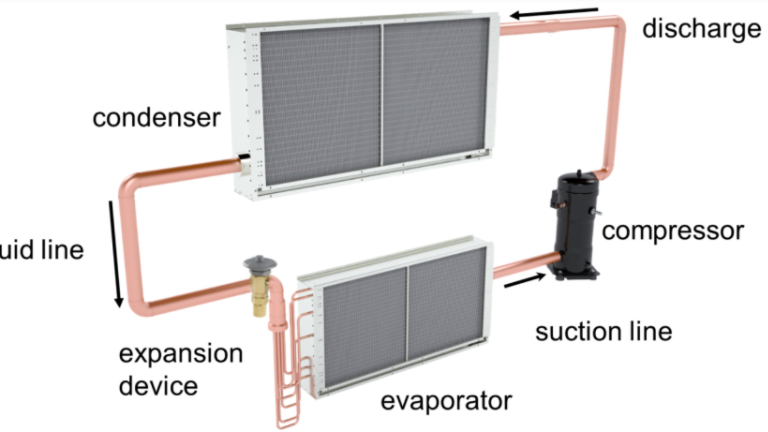
The refrigeration vapor compression cycle is the path that refrigerant takes through your commercial HVAC system’s components to facilitate heat transfer and cooling. A refrigeration cycle at a minimum consists of a compressor, condenser, expansion device and evaporator components. Successful completion of the refrigeration cycle is essential for maintaining comfort in commercial spaces during warmer months. The cycle works by removing heat from the interior of the building, effectively cooling it down.
The refrigerant cycle as stated above has four fundamental components: the compressor, the condenser, the expansion device, and the evaporator. Let's examine each one:
A vapor compression refrigeration system can reject heat in either direction depending on how it is applied for the application. In the summer, heat is removed from the space to provide comfort, and this heat is rejected to the outside. In the wintertime, the refrigeration cycle can be reversed or designed as a heat pump, which then moves heat from cooler outdoor temperature and provides heating comfort to the occupied space. A heat pump runs in reverse from an air conditioner where the coil inside your building becomes the hot coil (the condenser), so that as the air in your facility blows across the coil, it is heated up, keeping your building warm.
Common problems in the commercial HVAC refrigeration cycle can cause your air conditioning system or heat pump to struggle or even fail to cool or heat your building adequately. Some issues include
Regular commercial HVAC maintenance can help you avoid many of these issues. If you're having trouble with your commercial air conditioning or heat pump cooling, contact a reliable commercial HVAC company for professional assistance.
For further guidance on maintaining your commercial HVAC system, consult maintenance resources or contact your local Trane representative for expert advice.